
Saturday, October 4, 2025

Saturday, April 7, 2012
Web SDR - HF Propagation
Observing the HF bands during contests can reveal some very interesting statistics about overall propagation spectrum usage, and especially during the start and end of contests.
At higher FFT resolutions, one can inspect the quality of signals such as this digital transmission on 20m. This snapshot was taken running my experimental web sdr
View live SDR here : http://safaridx.com/web-sdr/ReleaseNotes.html


At higher FFT resolutions, one can inspect the quality of signals such as this digital transmission on 20m. This snapshot was taken running my experimental web sdr
View live SDR here : http://safaridx.com/web-sdr/ReleaseNotes.html

Digital mode on 20m (using 8k FFT) using websdr
When observing digital signals, where transmitter energy is evenly distributed across the 2.8KHz transmitter bandwidth, the effects of rapid path fading, as a result of ionospheric conditions between the transmitter and receiver stations, become very visible.
This received digital signal to the right clearly shows the effects of fading - which would have had less impact on SSB voice transmission (left) , but because the even energy distribution, clearly shows the differential signal strength, for frequencies across the 2.8KHz pass-band.
By comparison, the SSB signal shows very little signs of fading. This could be a result of the different origin of the SSB signal (and of course the fact the the energy distribution of SSB makes it less obvious for casual observation)

Rapid fading visible in the 2.8KHz digital signal. (Using websdr)
Monday, March 19, 2012
WWW-SDR - Intro Video
I've always thought that SDR had good promise for visuals and demonstrating the fun side of Amateur Radio today. I put together a quick intro video, using content from my www-sdr client, running in a www browser with a link to the live wwwSDR. (requires Browser + Java add-on)
http://www.youtube.com/watch?v=yG2Uo_sL-Rs
Please leave your comments on quality of audio, UI ease of use, or any other thoughts.
73, happy hf watching - as the solar cycle picks up.
Fun Side of SDR.
http://www.youtube.com/watch?v=yG2Uo_sL-Rs
Please leave your comments on quality of audio, UI ease of use, or any other thoughts.
73, happy hf watching - as the solar cycle picks up.
Fun Side of SDR.
Sunday, March 18, 2012
WWW-SDR
Improved network bandwidth usage by using loss-less compression for both data and audio streams.
Audio streaming compression using AAC is in progress. Audio streaming ~ avg 48kbs.
Improved some of the colormaps - although not a priority at this time. Server-side performance improvements are ongoing, especially the DSP section. (BPF, Demod)
Feel free to connect to the live server. Any comments/feedback are always appreciated.

Audio streaming compression using AAC is in progress. Audio streaming ~ avg 48kbs.
Improved some of the colormaps - although not a priority at this time. Server-side performance improvements are ongoing, especially the DSP section. (BPF, Demod)
Feel free to connect to the live server. Any comments/feedback are always appreciated.

Tuesday, January 17, 2012
How to replace the Icom IC-725 LCD lights
I used this method for replacing LCD backlight bulbs on the Icom IC-725. The LCD backlighting is provided by 3 x miniature 12V bulbs (not LEDs). Each lamp is help in place in a hole behind the display.
The limited access behind the front panel is the main constraint in replacing the bulbs.
Ensure to follow the standard safety precautions - ie. the radio is disconnected, and remove any connected devices, Mic, CW Key, data connectors, etc.
NOTE: This procedure does NOT require the removal of the front-plastic panel.
There are 3 x 12V mini lamps (backlights to the LCD panel) which can be access via the gap between the heatsink, and the front panel when it's in the rotated state.
Left lamp (meter backlight) is clearly visible here:
This lamp is easy to reach, and replace. See below.
Middle Lamp (LCD left backlight)
The middle lamp is the trickiest to replace, due to the placement behind the mounting bracket, which leaves very little space for a soldering iron, and tweezers to grab the lamp leads and maneuver the new one into place. To complicate matters, the soldered connected wires, are sort of in the way. Be careful not to sever these connections while working on this lamp.
Right Lamp (LCD right backlight)
This lamp is also easy to reach and replace. It is also clear of the mounting plate.
The process for replacing the bulbs, simply involves unsoldering, and replacing with equiv 12V lamps. You can re-use the yellow sleeve. (This is what gives the backlight the yellow tint). You can experiment with other colors, for a different effect. I chose to re-use the sleeves, for the original effect.
Front panel view
This view shows the relative locations of each of the lamps, and their back-light effect on the meter and LCD panel when the radio is powered on.
Good luck on replacing the bulbs to give your IC725 a new look again.
Please send comments if you think this was helpful.
73 and happy maintenance.
The limited access behind the front panel is the main constraint in replacing the bulbs.
Ensure to follow the standard safety precautions - ie. the radio is disconnected, and remove any connected devices, Mic, CW Key, data connectors, etc.
NOTE: This procedure does NOT require the removal of the front-plastic panel.
- Follow the instructions found in the user manual for removing the top/bottom covers.
- Remove 2 x the screws on top which holds the front-panel connected to the heat sink.
- Remove the 2 x Left and 2 x Right side screws holding the front panel in place.
- With the 6 x screw removed, the front panel should be free to be tilted down (away from the heatsink) See pic below. Be careful not to tilt too far. The connecting wires between front panel and the bottom (circuit board side of the radio) is short, and only allows for a little play.
 |
| Left View |
 |
| Left/Top View - showing the access gap, after rotating the front panel down. |
- The top side of the front panel can be rotated away from the heatsink, allowing about 1 inch space between the heatsink and front panel assembly. This is the gap through which you will access replace the lamps.
 | |
| Top view |
The image below indicates the locations of each of the 3 x lamps.
 |
| Relative Lamp Locations when viewing from the heat-sink side. |
Left lamp (meter backlight) is clearly visible here:
This lamp is easy to reach, and replace. See below.
 | ||||||
| Meter Backlight (Leads visible, with light bulb inserted into socket and yellow sleeve) |
The middle lamp is the trickiest to replace, due to the placement behind the mounting bracket, which leaves very little space for a soldering iron, and tweezers to grab the lamp leads and maneuver the new one into place. To complicate matters, the soldered connected wires, are sort of in the way. Be careful not to sever these connections while working on this lamp.
 | ||||
| Middle Lamp (trickiest to get to, since it's behind the mounting bracket) |
Right Lamp (LCD right backlight)
This lamp is also easy to reach and replace. It is also clear of the mounting plate.
 |
| Right Lamp (LCD right side backlight) |
The process for replacing the bulbs, simply involves unsoldering, and replacing with equiv 12V lamps. You can re-use the yellow sleeve. (This is what gives the backlight the yellow tint). You can experiment with other colors, for a different effect. I chose to re-use the sleeves, for the original effect.
Front panel view
This view shows the relative locations of each of the lamps, and their back-light effect on the meter and LCD panel when the radio is powered on.
 |
| Front panel view - indicating relative lamp location. |
Good luck on replacing the bulbs to give your IC725 a new look again.
Please send comments if you think this was helpful.
73 and happy maintenance.
Tuesday, November 29, 2011
WWW-SDR - Multi-tuner
To demonstrate the ability to run multiple tuners at once, I configured the server to run 3 x tuners concurrently. The www view demonstrates this view, with multiple spectrum modes as well. Each receiver can be controlled independently of the others - but combined in a single www view.


Ability to view multiple receivers via a single browser.
Saturday, November 26, 2011
2011 - SDR with CQWW DX CW
After many performance experiments (server vs. browser) the SDR processing still lives on the server.
I have uploaded about 7 mins of 96KHz sample data from the 2011 CQ WW DX CW contest.
Feel free to try it out here
Please leave comments and feedback. This is a work-in-progress project, and has served as a vehicle for DSP technique experimentation, while having fun with weak signal modes.

I have uploaded about 7 mins of 96KHz sample data from the 2011 CQ WW DX CW contest.
Feel free to try it out here
Please leave comments and feedback. This is a work-in-progress project, and has served as a vehicle for DSP technique experimentation, while having fun with weak signal modes.

Monday, September 5, 2011
WWW-SDR : Multi-decode view.


This view above demonstrates the ability to run multiple independent radios in a single www browser.
In this example, both www-radios are connected to the same SDR server but running different waterfall modes
The multi-threaded server architecture supports multiple radios, each serving multiple www-clients.
Server-side capacity is mostly limited by network I/O & CPU.
Read more about the features and release notes here.
Sunday, August 21, 2011
HF-SSTV

Around 0630Z, 20m was open to Japan. Here you can see the clear trace from SSTV tx from JA2GZZ
on 14.233MHz.
SDR functionality is now almost complete. From the browser you can Tune, Filter & Demodulate
audio.
The SDR radio is now usable, via anywhere on the www.
73, Deon

Sunday, March 27, 2011
Internet SDR - audio streaming

Project notes here:
Added audio streaming to the www client. Also more UI features such as display pan/zoom
and controls for pause/muteof the data feeds - which will optimize the network bandwidth usage.
I'm now working on adding full SDR receive capability to the www client.
This will allow multi-vfo tuning of the radio from the client.
Feel free to connect as often as you like. The radio is mostly tuned to the high bands during daytime, and
40m at night time Pacific time.
Friday, March 18, 2011
Online SDR - Its alive.
The Online SDR project has been coming along nicely.
The results of a few late nights work appears to be working good so far.
The multi-digital decoding engine is also working fb.Now that the digital decoder is working, then next step is to implement a fully internet enabled SDR.
If you want to follow along, project notes can be found here: ReleaseNotes.

The SDR server and UI supports multi-radio capability.

The results of a few late nights work appears to be working good so far.
The multi-digital decoding engine is also working fb.Now that the digital decoder is working, then next step is to implement a fully internet enabled SDR.
If you want to follow along, project notes can be found here: ReleaseNotes.

Here is a snapshot of the Online SDR (Single radio mode)
The SDR server and UI supports multi-radio capability.

Independent radios can be visible in a single view view.
Saturday, January 15, 2011
Jan Mayen 2011 - JX7VPA
You can follow the status of planning on dx-world.net.
http://dx-world.net/2011/jx7vpa-jan-mayen-2011/
Stan SQ8X is pleased to announce that today he has received an email from The Norwegian Post and Telecommunications Authority (NPT) granting ham radio license – and permission to transmit from Jan Mayen island.
JX7VPA will be a group callsign used during the DXpedition scheduled for July this year.
The timetable as follows:
The team will have a professional TV crew onboard that will prepare a broadcast documentary about the project and the island. All details as updated operators’ list, QSL route, bandplan and such will be announced soon on a dedicated website http://janmayen2011.org (under construction).
http://dx-world.net/2011/jx7vpa-jan-mayen-2011/
Stan SQ8X is pleased to announce that today he has received an email from The Norwegian Post and Telecommunications Authority (NPT) granting ham radio license – and permission to transmit from Jan Mayen island.
JX7VPA will be a group callsign used during the DXpedition scheduled for July this year.
The timetable as follows:
- July 2 – the team gathers in Reykjavik, Iceland.
- July 4 – departing for Jan Mayen with a charter yacht, 2 days on the sea with a chance to sign as /mm.
- July 6-14 – ON THE AIR.
- July 14 – tearing the camp down, sailing back to Iceland.
- July 16 – back in Iceland.
The team will have a professional TV crew onboard that will prepare a broadcast documentary about the project and the island. All details as updated operators’ list, QSL route, bandplan and such will be announced soon on a dedicated website http://janmayen2011.org (under construction).
Tuesday, January 11, 2011
2010 - ZS1D Piketberg Portable
Dec 17 - 20, 2010.
Our mountain top location for this trip is about 100 miles north of Cape Town. 1800ft elev.


The multi-band vertical is easy to setup and the station is on-air within minutes. Antenna is based on a design from the ARRL handbook - multi-band design based on a bottom loaded design.

 Scanning the 40m band results in a few local QSO's but nothing too exciting. We easily establish contact with ZS stations about 1000 miles away. During the afternoon, 20m opens up with some longer distance dx.
We easily manage a few QSO's with Europe around 14h00Z.


Our mountain top location for this trip is about 100 miles north of Cape Town. 1800ft elev.


The multi-band vertical is easy to setup and the station is on-air within minutes. Antenna is based on a design from the ARRL handbook - multi-band design based on a bottom loaded design.


We easily manage a few QSO's with Europe around 14h00Z.


Our Cabin under the clear Milky Way night sky.
During the late afternoon, 20m grayline allows an easy path to EU. Soon after that the path switches to NA, with both 20m and 40m paths between 17h00Z - 20h00Z.
706 with Vertical and the view from the shack


Roelof, ZS1XD taking a well-deserved break from all that dx...

The field kitchen at the nearby camp site.

View from the shack - looking east towards the reflection of sunset

Sunday, December 12, 2010
2010 - ZS1D Safari dx.
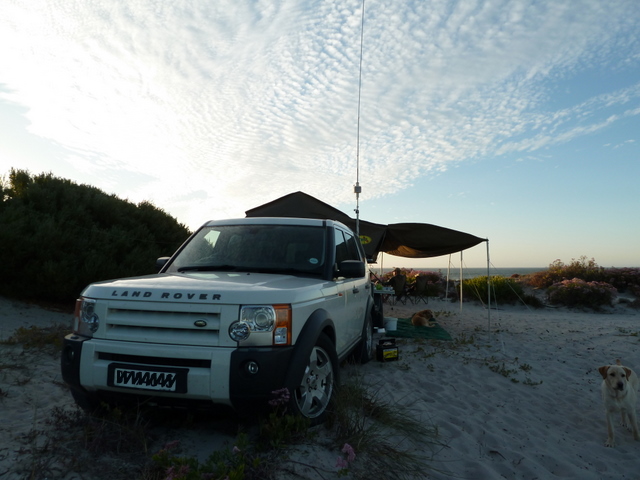
Trying out the new multi-band vertical turned out to be quite successful.
This location on the beach north of Cape Town is rf-free. DX fills the bands, especially 40m night time is full of EU, NA, OC dx.
ZS1D logs for Dec 2010 are now available via LOTW.
Feedback, comments and SWL reports are very welcome - in particular if you heard my CQ call, but
for some reason I could not copy you?


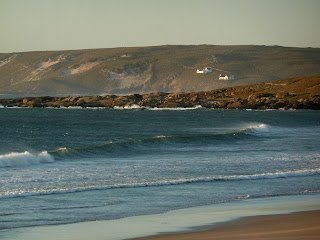

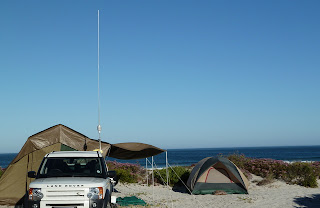

This location on the beach north of Cape Town is rf-free. DX fills the bands, especially 40m night time is full of EU, NA, OC dx.
ZS1D logs for Dec 2010 are now available via LOTW.
Feedback, comments and SWL reports are very welcome - in particular if you heard my CQ call, but
for some reason I could not copy you?
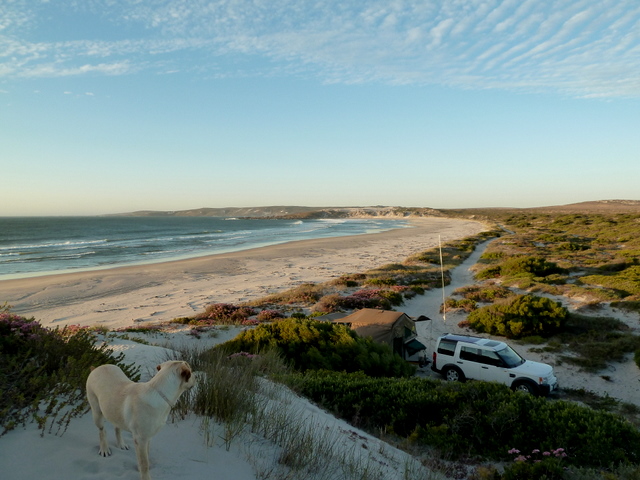
Beach camp - /p with battery power and lots of fresh air along this stretch of deserted beach.
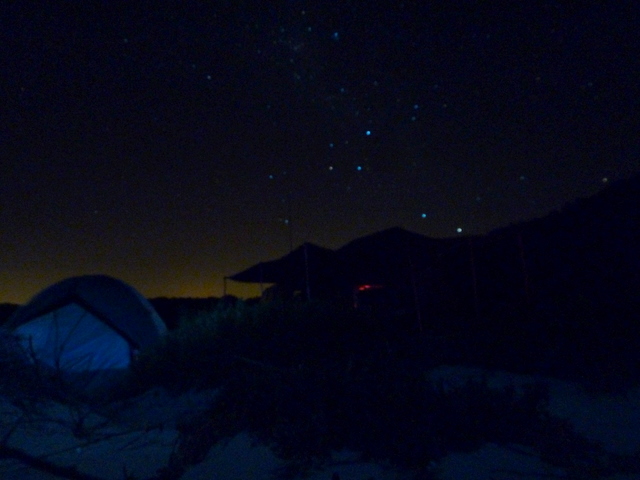
Under the milky way - with the Southern Cross clearly visible. The milky way is so bright, one can almost read a book at night.

Typical sunset wave action

Multi-band vertical - top section = 12ft, which is easily supported against the vehicle. A single counterpoise is extended to match the operating band.

DX Breakfast : A room with a view + dx.
This vertical goes on the air in abt the time it takes to slide 3 pieces of Al tubing together.
Sunday, October 31, 2010
SDR-Audio : CQ WW DX SSB Contest.
With the CQ WW DX SSB contest in full swing, I captured some interesting callsigns audio clips on 15, 20, 40 this weekend.
Receiving station:
Rig: Softrock SDR
Ant: Wire vertical over salt water.

Receiving station:
Rig: Softrock SDR
Ant: Wire vertical over salt water.

15m 1815Z
Tuesday, October 12, 2010
DSP, $5 Linux server, cognitive radio and more...
Well, it's been a while since posting here, mainly because I've been investing some time in educating myself in the world of DSP s/w.
Some new pieces of SDR gear made it past the bench and into the shack The latest Softrock Ensemble rx is now online,
and I must say the new pcb design is much cleaner and compact from a constructor's perspective. It's performance on par with the previous v9.0.
The next step was to dedicate a Linux system for SDR experimentation. As the good fortune would have it, I was lucky enough to pickup a desktop PC, in immaculate condition at the local swap meet. It became the dedicated Ubuntu platform and now serves as my main development platform.
Ubuntu desktop installation is a snap, and with the added dev-tools a scap PC is transformed into a capable development platform. Ubuntu's S/W manager makes things really easy.
SDR and Cognitive Radio
Experiments around the automation of decision making for the purpose of detecting information via rf sensing technologies can cover a wide range of topics. For the Amateur Radio experimenter, there are several benefits and utility to this exciting field. Propagation studies are among the very useful outcomes of cognitive radio. In the context of two-way communications, ionospheric path optimization could be another interesting outcome of path discovery/and auto selection between two/more terrestrial locations.
H/W:
As the chip manufacturers push the A/D envelope and DSP integration becomes more affordable, we have access to a level of instrumentation sophistication which has never been available before.
S/W
Unix/Linux is of course a very capable networked O/S - which is perfect for radio work, as well as a powerful s/w development platform for doing DSP development work.
Design considerations.
To approach the problem of concurrent decoding of multiple digital data streams, and adding a level of control logic to make decisions about decoding activities over time, an understanding of a few key concepts are necessary. Here is an interesting write-up on the general progress and concepts of SDR.
DSP concepts.
With the advances and adoption of SDR technology, the technical components for cognitive radio are in place today.
Useful references:
The Scientist and Engineer's Guide to Digital Signal Processing is a good starting point for DSP concepts.
Do you understand the SDP concept?
Some new pieces of SDR gear made it past the bench and into the shack The latest Softrock Ensemble rx is now online,
and I must say the new pcb design is much cleaner and compact from a constructor's perspective. It's performance on par with the previous v9.0.
The next step was to dedicate a Linux system for SDR experimentation. As the good fortune would have it, I was lucky enough to pickup a desktop PC, in immaculate condition at the local swap meet. It became the dedicated Ubuntu platform and now serves as my main development platform.
Ubuntu desktop installation is a snap, and with the added dev-tools a scap PC is transformed into a capable development platform. Ubuntu's S/W manager makes things really easy.
SDR and Cognitive Radio
Experiments around the automation of decision making for the purpose of detecting information via rf sensing technologies can cover a wide range of topics. For the Amateur Radio experimenter, there are several benefits and utility to this exciting field. Propagation studies are among the very useful outcomes of cognitive radio. In the context of two-way communications, ionospheric path optimization could be another interesting outcome of path discovery/and auto selection between two/more terrestrial locations.
H/W:
As the chip manufacturers push the A/D envelope and DSP integration becomes more affordable, we have access to a level of instrumentation sophistication which has never been available before.
S/W
Unix/Linux is of course a very capable networked O/S - which is perfect for radio work, as well as a powerful s/w development platform for doing DSP development work.
Design considerations.
To approach the problem of concurrent decoding of multiple digital data streams, and adding a level of control logic to make decisions about decoding activities over time, an understanding of a few key concepts are necessary. Here is an interesting write-up on the general progress and concepts of SDR.
DSP concepts.
With the advances and adoption of SDR technology, the technical components for cognitive radio are in place today.
- First, a reasonable understanding of DSP is needed when tinkering with S/W methods for signal processing. The several phases of processing a signal undergoes through digital acquisition, digital processing and filtering and subsequent decoding, are all significant in laying the basis for S/W DSP.
- Secondly, DSP happens in real time, and therefore the processing speed becomes a consideration when selecting a O/S platform - when done right, interesting opportunities await - eg. dx-spotting, "steering passive antennas" by means of S/W phase shift, diversity reception, etc.
Useful references:
The Scientist and Engineer's Guide to Digital Signal Processing is a good starting point for DSP concepts.
Do you understand the SDP concept?
Saturday, May 29, 2010
SDR Reports
Using PSK Reporter is a really helpful system for tracking propagation.
Here is a sample of what my 20m SDR receiver sees during a 24 hr cycle.
Here is a sample of what my 20m SDR receiver sees during a 24 hr cycle.
Sunday, May 2, 2010
Softrock : Miles per watt.
With recent propagation, 20/40m has been really great for grayline dx. A very active QSO party weekend added some more long distance QRPp Qs.
Rig: - Softrock txrx 6.3 running at max 1W, - (300-500mW just for fun)
Antenna: was wire vertical over salt water (somewhat sloped config
(Distances in miles)
Rig: - Softrock txrx 6.3 running at max 1W, - (300-500mW just for fun)
Antenna: was wire vertical over salt water (somewhat sloped config
(Distances in miles)
Date        Start    Station  Band  Mode My Power Distance   QTH
5/2/2010  04:48    K1TTT   40m    CW    1W    2,478.45    PERU
5/2/2010  04:44    W7POE   40m    CW    1W    1,065.37    BURIEN
5/2/2010  04:42    K7LFY   40m    CW    1W    1,090.35    ADDY
5/2/2010  04:34    KK7S    40m    CW    1W    1,071.44    MEDINA
5/2/2010  04:32    N7BV    40m    CW    1W    1,118.16    PORT ANGELES
5/2/2010  04:30    W7UG    40m    CW    1W    906.60      SALEM
5/2/2010  04:22    W7GKF   40m    CW    1W    1,084.23    Snohomish
5/2/2010  04:21    K7ZSD   40m    CW    1W    961.20      SCAPPOOSE
5/2/2010  04:11    K7MI    40m    CW    1W    826.58      BANDON
5/2/2010  04:10    W7AR    40m    CW    1W    929.78      WEST LINN
5/2/2010  00:36    KX7L    20m    CW  300mW   1,085.29    BOTHELL
5/2/2010  00:22    K7HBN   20m    CW  300mW   1,088.06    BOTHELL
5/2/2010  00:19    AB7R    20m    CW  300mW   1,122.27    OAK HARBOR
5/1/2010  23:43    W7RN    20m    CW  500mW   487.45      VC HIGHLANDS
5/1/2010  23:38    N7BV    20m    CW    1W    1,118.16    PORT ANGELES
5/1/2010  23:26    KI7MT   20m    PSK31 1W    1,015.82    HELENA
5/1/2010  23:17    W1KM    20m    CW    1W    2,594.23    MARSTONS MILLS
5/1/2010  23:10    WG7Y    20m    CW    1W    1,020.32    GILLETTE
5/1/2010  23:06    W7GKF   20m    CW    1W    1,084.23    Snohomish
5/1/2010  22:11    K7QQ    20m    CW    1W    1,064.91    Olalla
5/1/2010  22:09    NZ1U    20m    CW    1W    2,525.26    E KILLINGLY
5/1/2010  22:03    KN7T    20m    CW    1W    1,088.06    BOTHELL
5/1/2010  21:58    AC7T    20m    CW    1W    1,075.91    REDMOND
5/1/2010  21:57    N7TT    20m    CW    1W       965.01   LA CENTER
5/1/2010  21:53    KK7S    20m    CW    1W    1,071.44    MEDINA
5/1/2010  21:41    K7SS    20m    CW    1W    1,070.89    SEATTLE
5/1/2010  21:40    W7VP    20m    CW    1W    1,081.45    WOODINVILLE
5/1/2010  21:30    KK7OO   20m    CW    1W    1,157.75    BELLINGHAM
5/1/2010  21:25    K7BG    20m    CW    1W    1,081.01    POWER
5/1/2010  21:24    W7AC    20m    CW    1W      942.16    ALOHA
5/1/2010  21:20    NG7Z    20m    CW    1W    1,085.29    BOTHELL
5/1/2010  21:18    K9SG    20m    CW    1W    1,808.46    GREENFIELD
4/25/2010 03:09    NV5E    20m    PSK31 750mW 1,163.11    ARLINGTON
4/25/2010 02:52    K5JJR   20m    PSK31 750mW 1,147.25    HASLET
4/25/2010 01:16    WA5MS   20m    PSK31 1W    1,165.94    HIGHLAND VILLAGE
4/25/2010 01:12    W5GT    20m    PSK31 1W    1,157.56    N RICHLAND HILLS
4/10/2010 09:37    JS1NDM  40m    CW    1W    5,576.71    Noda City Chiba
4/10/2010 09:07    JA7DLE  40m    CW    1W    5,379.44    Hanamaki
4/10/2010 08:30    JA1XMS  40m    CW    1W    5,600.02    Chiba City
4/10/2010 08:17    JF2QNM  40m    CW    1W    5,752.96    My shack :CHITAGUN
4/10/2010 04:31    KI7MT   40m    PSK31 1W    1,015.82    HELENA
Friday, March 5, 2010
2010 ARRL CW DX Contest - portable operation
Another edit of some of the activities during the recent 2010 ARRL CW DX Contest. Events such as this are really useful for tweaking your station configuration. With a low power portable station, the dx contest is especially helpful, because of the test requirement to "work dx only".
Here is a view of some of the weekend activities, which I conducted from the hills just east of San Diego.
It was a cool day, with the temp hovering around freezing - (31F)
Here is a view of some of the weekend activities, which I conducted from the hills just east of San Diego.
It was a cool day, with the temp hovering around freezing - (31F)
Sunday, February 28, 2010
Subscribe to:
Posts (Atom)